

A thriving business balances organisational, user and staff needs
Why do organisations exist?
To provide people with what they need (or think they need).
As someone who works in service design and user research, I’m fascinated by the sweet spot where an organisation’s needs balance perfectly with its users’ needs.
This balance is constantly shifting, requiring organisations to sense and respond dynamically. If an organisation cannot achieve this balance, it will struggle to succeed.
For example:
- Too much focus on the organisation rather than the user experience can result in irrelevance
- Too much focus on users rather than the organisation can result in dispersed and ineffective resource allocation.
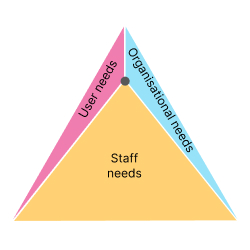
Over the years, I’ve come to realise there’s an important part of this model missing: staff needs.
Staff are continuously balancing organisational, user and their own (or colleagues’) needs. They make trade-offs all the time, often sacrificing their own needs for the organisation or users’ benefit.
A truly thriving organisation must balance all three in a symbiotic way, where each element supports and strengthens the others:
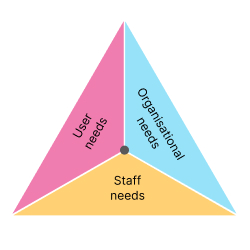
- Organisational needs
- User needs
- Staff needs
Let’s look at each of these needs in turn to see what can happen when the balance is off and how we can get it back.
Organisational needs
An organisation needs financial sustainability, operational efficiency, and strategic clarity to enable its people to organise and collaborate effectively. All of this is ultimately driven by its purpose.
However, too much focus on organisational needs can drain staff as they sacrifice themselves and their users’ needs to achieve these objectives, resulting in stress and burnout. This may also show up as an entrenched focus on fixed delivery rather than adaptability based on user feedback or market changes. Or even doubling down on new technology or infrastructure projects without innovating working practices alongside them.
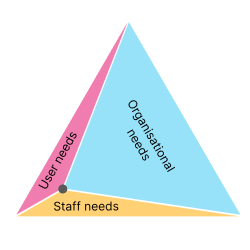
On the other hand, too little focus on organisational needs can mean a lack of strategic direction. This can result in organisational drift, making it hard for users to understand the offer and for staff to rally behind it. This might show up in an organisation as low customer acquisition, difficulty differentiating in the market or an unclear focus for staff as they work on misaligned tasks, manage internal conflicts and waste effort.
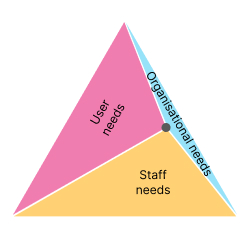
If you think your organisation isn’t doing enough to meet organisational needs, here are some actions you can take:
- Establish a clear and well-communicated organisational purpose.
- Create accountability for that purpose – a single source who understands the organisation’s history and how the purpose has changed. Someone who can hold and embody that purpose, who can clarify boundaries (what’s in or out of the purpose) and recognise when the purpose needs to evolve.
- Connect all activities to the purpose, via sub-purposes, so everyone is heading in the right direction.
- Set sustainable expectations about what the organisation can deliver and regularly review priorities.
User Needs
Users are drawn to an organisation, hoping it will meet their needs. If it doesn’t, the organisation will fail.
Too much focus on users can lead to being so heavily led by them (audience, customers or shareholders) that an organisation over-diversifies and weakens its direction. It also might end up destroying resources (people and planet) in its quest to satisfy these needs. For example, trying to cater to every user request can lead to a scattered strategy, weakened brand identity, and an unsustainable use of resources.
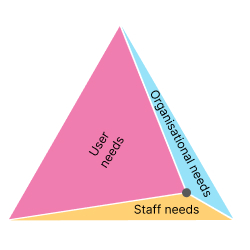
Too little focus on users can result in being too organisationally led and blind to what is happening ‘out there’. This may show up in an organisation as low customer acquisition and retention, failure to find product/market fit, high volume of support requests, and missed opportunities for innovation.

If you think your organisation isn’t doing enough to meet user needs, here are some actions you can take:
- Conduct user research. To focus on the right type of user research, think about where you have the most to learn from your users and what impact the outcomes might have on them and the organisation.
- One method is to go broad; understanding different types of users, their needs, feelings, behavioural patterns and pain points.
- Another is to zoom in on the ease of a specific experience. Leveraging usability testing to identify small tweaks that can significantly enhance user satisfaction and retention.
Staff Needs
Staff enable the organisation to fulfil its purpose and meet user needs. Their engagement is critical to the organisation’s success.
However, if an organisation focuses too much on the needs of its staff, it can end up overcompensating for them at the expense of the organisation and its users. This is more commonly seen in charities and the public sector, where ‘caring for each other’ is often highly valued. This overly kind culture can, in effect, kill an organisation. Avoiding difficult conversations, failing to provide timely feedback, a lack of clarity about accountabilities, and not having conversations about performance, all negatively affect the individuals, their colleagues, and the organisation’s long-term chances of success.
At the other end, and also common, is too little focus on staff needs. Many people are working in cultures where they are seen as a resource to be used up by the company with little care for the individual. Such neglect can lead to low engagement, unhappiness at work and reduced motivation. This often shows up in an organisation as high staff turnover, reduced creativity and innovation, and failure to adapt in response to change.

If you think your organisation isn’t doing enough to meet staff needs, here are some actions you can take:
- Assess the current staff experience—what’s getting in their way?
- Prioritise areas where changes will have the greatest impact.
- Help teams build trust and psychological safety, and understand complexity.
- Strengthen relationships by prioritising time for deeper connections, such as meeting check-ins and support pods.
- Implement systems that foster agility, autonomy and accountability, such as dynamic roles.
- Recognise and value hidden care work.
- Role-model desired behaviours, such as shifting from managing others to doing the work.
- Put in place coaching and mentoring over rigid control structures.
Earth’s Needs
I’ve wondered about adding Earth’s needs as a fourth dimension to the model. This would make sense as we are all making trade-offs in this regard. But I have currently settled on adding an environmental lens to each pillar to enable us to see how all our actions can be more aligned with a thriving planet.
Organisational needs: How might our purpose have a positive impact on our planet? How might it contribute to a sustainable and regenerative future?
User needs: How might our products and services be more sustainable and regenerative? How might we reduce over-consumption and environmental harms?
Staff needs: How might we be more connected to nature and each other? How might we reduce waste and minimise harm to people and the planet?
Achieving balance
Organisations thrive when they balance all three needs, in a symbiotic way. The three are in constant moving tension with each other rather than in static perfection. The value in this simple model is the ability to regularly check where you are; if you are in balance or need to adapt.
The three trade off against each other to achieve balance. Not all needs can (or should) be met. So another benefit of the model is having conversations and bringing to the surface any hidden assumptions about what is or isn’t being prioritised. It’s good to acknowledge the current situation and how we feel about it at this moment in time. Are we ok for now? Do we need to change something? How might we move towards better balance in future?
A call to action
- Where does your organisation or team stand right now?
- Are you over-investing in one area and neglecting another?
- Reflect on what’s brought you to that position, how well it’s working and how you can move towards greater balance. Sometimes, it’s enough to bring the trade-offs you are making to the surface so everyone is at least aware and consents for now.
- Add the environmental lens to change your actions and create a future in which we can all thrive.
Balancing needs isn’t just an organisational challenge – it’s a personal one too. We’re all trying to balance the things we are working on, our needs, and the needs of those close to us. Too much or too little in any area can impact our happiness, balance and how we show up at work. How balanced are you right now? And how about those around you?
If you’d like some help in your team or organisation, either through mentoring and support, or if you need someone to do the work, please get in touch.
 Helen Triggs